
NEWS
Despite Supreme Court Ruling, President Trump Announces 15% Global Tariff
In one of the most controversial moves in recent U.S. trade policy history, U.S. President Donald Trump has announced a 15% global tariff on imported goods, even after the Supreme Court of the United States ruled that the original tariff framework was unlawful. This policy decision has sparked global attention, drawing reactions from governments, corporations, and economic analysts on the future direction of international trade.
The announcement signals a substantial shift in America’s approach to trade and tariff policy, raising questions about global supply chains, international relations, and the legal boundaries of executive trade authority.
Background: Supreme Court Decision and Trade Authority
In February 2026, the U.S. Supreme Court ruled that several of the tariffs imposed by the Trump administration were invalid and unconstitutional, asserting that the president lacked the legal authority to unilaterally impose broad tariffs without congressional approval. The court ruled that only Congress has the power to enact large-scale trade tariffs under the U.S. Constitution, not the executive branch acting alone.
Following this ruling, the administration immediately sought alternative legal avenues to maintain and expand tariff policy, utilizing provisions of the Trade Act of 1974, particularly Section 301 and other trade remedy measures. These statutes empower the U.S. government to impose tariffs in response to unfair trade practices or for national economic interests.
Instead of abandoning its tariff agenda, the administration publicly announced an updated plan to impose a 15% global tariff on imports, broadening the scope of previous tariff policies and creating new uncertainty for exporters and importers worldwide.
Key Features of the New 15% Global Tariff
1. Tariff Increase from 10% to 15%
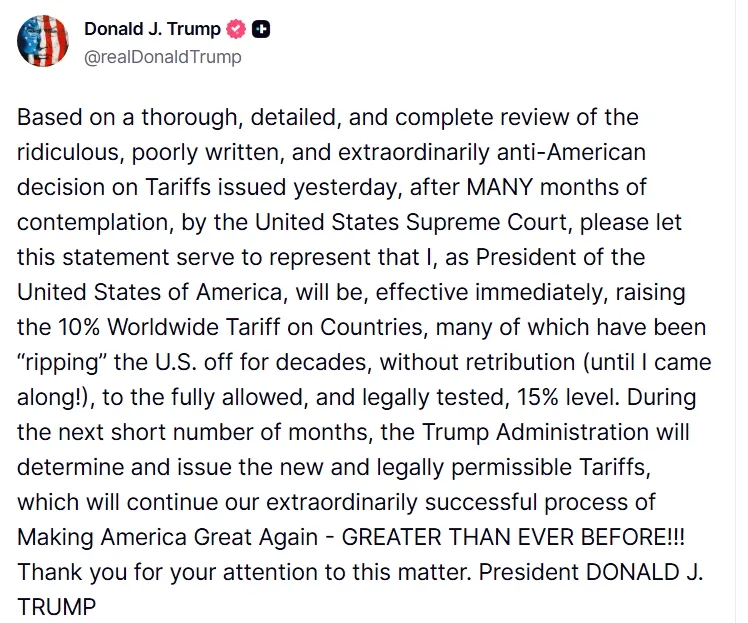
After the Supreme Court’s decision nullified the original tariff order, the U.S. government initially reimposed a 10% global tariff on imported goods using alternative statutory authority. However, in a public announcement on social media, President Trump declared an increase of this tariff to 15%, emphasizing it as an immediate measure to protect U.S. industrial competitiveness and national interests.
This new tariff is intended to apply across a wide range of imported products unless otherwise exempted through existing trade agreements.
2. Broad Application to All Countries
The imposed 15% tariff is designed to apply to imports from all trading partners, with limited exemptions for countries covered under existing bilateral or multilateral free trade agreements (FTAs). However, implementation specifics and the list of exemptions remain under review and may be subject to negotiation or future clarification by U.S. trade authorities.
3. Timeline and Legal Status
While the 15% tariff has been announced as policy, its official implementation and enforcement timeline is still pending regulatory approval and administrative procedures within U.S. trade authorities. Currently, the effective tariff rate collected at customs remains at 10% in many cases, awaiting the formal rulemaking process for the new rate.
This has created a period of uncertainty for importers, exporters, and international trade stakeholders as they adjust to the changing tariff landscape.
International Reactions and Global Impact
European Union and Trade Partners Speak Out
The announcement of the proposed 15% global tariff has prompted swift reactions from international leaders, particularly European Union officials. EU representatives have criticized the policy as potentially violating existing trade agreements and disrupting established trade relationships.
The European Commission has publicly stated that any new tariff measures must be consistent with existing trade commitments. EU leaders warned that unilateral increases could lead to trade disputes and retaliation, urging the U.S. to consult with trading partners and uphold World Trade Organization (WTO) principles.
Business Community and Market Response
Following the tariff announcement:
- Hundreds of U.S. companies filed lawsuits demanding refunds of previously paid tariffs, arguing that the Supreme Court’s decision invalidated prior tariff collections.
- Global financial markets experienced increased volatility amid concerns over pricing, supply chain restructuring, and rising import costs.
- Export-oriented businesses in Asia and other regions began adjusting their supply chain strategies to mitigate the long-term effects of higher tariff barriers.
These developments highlight the far-reaching implications of tariff policy shifts on international trade dynamics.
Impact on Trade, Supply Chains, and Logistics
Rising Import Costs
If fully implemented, a 15% global tariff would significantly raise the cost of imported goods into the United States. Higher tariffs tend to:
✔ Increase landed costs for manufacturers and retailers
✔ Raise consumer prices on imported goods
✔ Reduce profit margins for importers
✔ Prompt reassessment of sourcing strategies
This cost increase directly affects global supply chains, as businesses may pass tariff expenses onto consumers or seek alternative suppliers in lower-cost markets.
Supply Chain Restructuring
Many multinational corporations may reconsider their supply chain footprints to minimize tariff exposure. This could include:
- Shifting production to U.S.-based facilities
- Sourcing raw materials from tariff-exempt markets
- Increasing reliance on domestic suppliers
- Diversifying production across multiple regions
Such strategic shifts would have profound implications for global logistics networks, freight patterns, and cross-border transportation demand.
Trade Tensions and Retaliation Risk
Several countries have hinted at potential retaliatory trade measures, including increased tariffs, limited market access, or formal WTO challenges if the global tariff is enforced without mutual agreement. Trade disputes of this nature risk escalating into broader protectionist cycles, potentially undermining global trade cooperation.
Key Considerations for Importers, Exporters, and Logistics Professionals
Given the uncertainty and potential impact of the new tariff policy, businesses engaged in international trade should consider the following:
? Monitor regulatory updates closely, as tariff policies may evolve during the rulemaking process.
? Reevaluate pricing strategies to account for increased duty expenses.
? Analyze supply chain flexibility, exploring alternative routes or sourcing to mitigate tariff impact.
? Engage logistics partners and customs experts for compliance guidance and tariff classification support.
? Prepare for possible trade disputes and legal challenges, especially if exemptions or exceptions are clarified.
The dynamic nature of global trade policy highlights the importance of proactive planning and careful risk assessment for businesses of all sizes.
Conclusion
The announcement of a 15% global tariff by the U.S. administration, despite a Supreme Court ruling, represents a major shift in international trade policy. While the tariff has not yetfully taken effect, its potential implications are already shaping market expectations, supply chain decisions, and trade negotiations worldwide.
For businesses operating in the global marketplace, this development underscores the need for strategic agility, comprehensive tariff impact analysis, and close collaboration with logistics and trade compliance professionals.
In an increasingly interconnected global economy, understanding and navigating tariff changes remains a critical priority for sustainable business growth and competitive advantage.








Recent Comments